
Two patients walk into our Phoenix office on the same morning. Both have lower back pain. Both have tried physical therapy and anti-inflammatories. Both have an MRI that mentions “degenerative changes.” Yet one leaves with a plan for an epidural steroid injection and the other with a plan for facet joint injections. If you have ever wondered how doctors make that call, and what the facet injection vs epidural decision means for you, this article is for you. I am Dr. Paul Lynch, CEO of Pain Arizona and a double board-certified pain care physician and anesthesiologist with 17 years in the Valley. I will explain the difference between the two injections, the clues we use to choose between them at our Phoenix clinics, and why the right answer depends on where your pain is truly coming from.
Two Injections, Two Different Targets
The single most important thing to understand is that facet injections and epidurals are not stronger and weaker versions of the same treatment. They target different structures that cause different kinds of pain.
An epidural steroid injection places anti-inflammatory medication into the epidural space, the area surrounding the spinal nerve roots. Its target is an inflamed or compressed nerve root, which commonly happens with a herniated disc or spinal stenosis. The hallmark of nerve root pain is that it travels: down the leg in the lower back, or down the arm in the neck.
A facet joint injection targets the facet joints, the small paired joints at the back of each spinal segment that guide and limit movement. Like knees and hips, they can develop arthritis and become painful. Facet pain tends to stay in the back or neck, sometimes spreading into the buttock or upper thigh, but usually not below the knee. A closely related procedure, the medial branch block, numbs the small nerves that carry pain from these joints.
So the core of the facet injection vs epidural question is really a diagnostic question: is your pain coming from a nerve root, or from a joint?
That is also why two neighbors with “the same” back pain can end up with completely different plans. One may have classic sciatica from a disc pressing on a nerve; the other may have stiff, achy arthritic joints that complain every time they stand at the kitchen counter. Same zip code, same MRI vocabulary, different pain generators.
Facet Injection vs Epidural: The Clues Our Phoenix Doctors Look For
When we evaluate a patient at our Phoenix offices, we gather several kinds of evidence before recommending either injection. No single clue decides it; we look for a pattern.
Where the pain goes. Pain that shoots below the knee, especially with numbness or tingling in a specific pattern, points toward a nerve root and an epidural. Pain that stays mostly in the low back, buttock, or upper thigh leans toward the facet joints.
What makes it worse. Nerve root pain from a disc often worsens with sitting, bending forward, coughing, or sneezing. Facet pain often worsens with standing for long periods, arching backward, twisting, and getting up after sitting. Spinal stenosis pain frequently worsens with walking and improves with sitting or leaning forward, as on a shopping cart.
The exam. Tests that stretch the nerve, such as raising a straight leg, may reproduce radiating pain from a nerve root. Pressure over the facet joints and back-extension maneuvers may reproduce facet pain. We also check strength, reflexes, and sensation.
The imaging. An MRI can show disc herniations, stenosis, and facet arthritis. But imaging must match symptoms. Many people have facet arthritis or disc bulges on an MRI that cause no pain at all, so we never treat a picture by itself.
Your history and goals. Prior injections and how you responded to them, other medical conditions, blood thinners, and what you most want to get back to all shape the plan. A retiree who wants to walk the neighborhood again and a contractor who needs to climb ladders may need the same diagnosis handled in different ways.
Before any facet injection vs epidural recommendation, I also ask patients a few questions to help them be active partners in the decision: Where exactly does it hurt, and where does it travel? What time of day is worst? Which positions bring relief? Those answers often tell us as much as the scan.
Not sure which injection fits your back pain? Get a precise diagnosis in Phoenix.
Pain Arizona – Phoenix
8805 N 23rd Ave #120, Phoenix, AZ 85021
1301 E McDowell Rd #100, Phoenix, AZ 85006
Call 480-626-2552
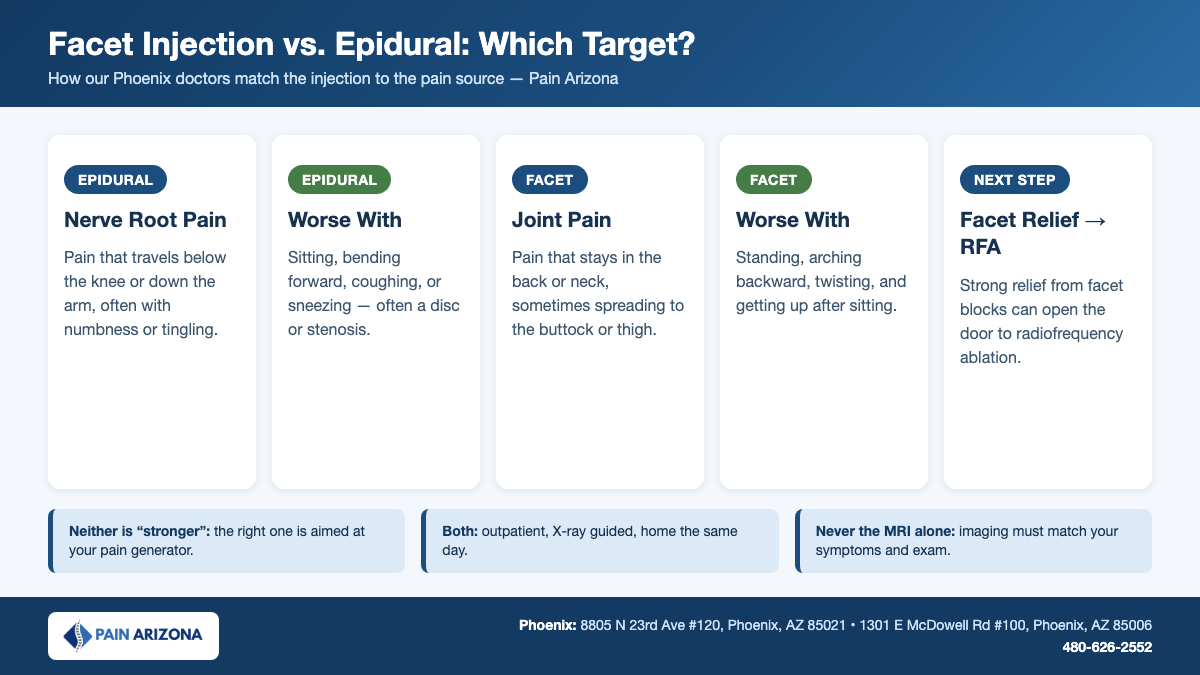
A Side-by-Side Comparison
Here is how I summarize the facet injection vs epidural comparison for patients who like to see it laid out:
- Target: Epidural treats inflamed nerve roots. Facet injection treats arthritic or irritated facet joints.
- Typical pain pattern: Epidural is for radiating leg or arm pain, sometimes with numbness or tingling. Facet injection is for localized back or neck pain that may spread to the buttock or shoulder area.
- Common causes: Epidural is used for herniated discs, stenosis, and nerve root irritation. Facet injection is used for facet arthritis and age-related joint wear.
- Diagnostic value: Both can help confirm a pain source. Facet-related blocks are especially useful because a clear response may open the door to radiofrequency ablation.
- Procedure: Both are outpatient, image-guided, and typically take well under an hour, with a same-day return home.
- Relief: Both can provide relief for weeks to months in many patients, though results vary from person to person.
Neither injection is better in general. The better injection is the one aimed at your pain generator. A perfectly performed epidural will not do much for arthritic facet joints, and a perfect facet injection will not calm an inflamed nerve root.
When the Answer Is Both, or Neither
Real spines are not always tidy. Some patients have a disc herniation and facet arthritis at the same time, and both may contribute to pain. In those cases, we usually treat the more dominant pain generator first, watch the response, and then decide whether the other source also needs attention. Staging treatment this way also tells us more about which structure is driving your symptoms.
Sometimes the answer is neither. If the pain pattern points to the sacroiliac joint, the hip, a muscle problem, or something outside the spine, the right next step may be a different injection, more targeted therapy, or further evaluation. Part of what you pay a specialist for is knowing when not to do a procedure. My philosophy has always been conservative first, and that includes making sure an injection is genuinely the right tool before we use it.
For a reliable, plain-language overview of the many causes of back pain, the National Library of Medicine’s MedlinePlus back pain page is a good starting point.
What Happens After a Facet Injection: The Path to RFA
One reason the facet injection vs epidural distinction matters so much is what comes next. If medial branch blocks or facet injections give you strong temporary relief, that response confirms the facet joints as a pain source. For patients whose relief fades, that confirmation can open the door to radiofrequency ablation, a procedure that uses controlled heat to quiet the medial branch nerves and can offer longer-lasting relief. Peer-reviewed summaries in the National Library of Medicine describe this approach in detail.
Epidurals follow a different path. If an epidural relieves radiating pain, the relief window is used to strengthen and rehabilitate, and the injection may be repeated within safe limits if symptoms return. If epidurals do not help as expected, we revisit the diagnosis and consider other options. In other words, the facet injection vs epidural choice is not a one-time fork in the road; it is the first step in a plan that adjusts to how your body responds.
What Both Procedures Feel Like at Our Phoenix Offices
Whether you are having an epidural or a facet injection at our Phoenix offices on 23rd Avenue or McDowell Road, the experience is similar. You lie on a procedure table, usually face down. We clean and numb the skin, then use live X-ray guidance, often with contrast dye, to place the needle precisely. The medication is delivered, the needle is removed, and you are monitored briefly before going home the same day with a driver.
Most patients describe pressure more than pain. Some feel temporary soreness at the injection site for a day or two. Relief from the anesthetic may be immediate and short-lived, while relief from the steroid typically builds over several days. We will give you a simple way to track your response, because that information guides what we do next.
Let our Phoenix doctors match the right injection to the real source of your pain.
Pain Arizona – Phoenix
8805 N 23rd Ave #120, Phoenix, AZ 85021
1301 E McDowell Rd #100, Phoenix, AZ 85006
Call 480-626-2552

Frequently Asked Questions
Which is better, a facet injection or an epidural?
Neither is better in general. The facet injection vs epidural choice depends on what is causing your pain. Epidurals target inflamed nerve roots and are usually chosen for radiating leg or arm pain. Facet injections target arthritic spinal joints and are usually chosen for localized back or neck pain. The right injection is the one aimed at your specific pain source.
Can I have both a facet injection and an epidural?
Yes, some patients have both a nerve root problem and facet arthritis. In those cases we typically treat the more dominant source first, evaluate your response, and then decide whether the second source needs treatment. Staging helps clarify which structure is driving your pain.
How long does relief from these injections last?
It varies widely. Some patients experience relief lasting weeks to months, others need repeat injections, and some do not respond as hoped. Facet-related relief that fades may make you a candidate for radiofrequency ablation, which can provide longer-lasting results for the right patient.
Does insurance cover facet injections and epidurals?
Many insurance plans, including Medicare, often cover both when documentation supports medical necessity, usually after a period of conservative care. Requirements vary by plan. Our team verifies your benefits and handles prior authorization where needed before scheduling. Call 480-626-2552 to get started.
The Bottom Line
The facet injection vs epidural decision is not about which procedure is more powerful. It is about matching the treatment to the true source of your pain: nerve root or joint. At Pain Arizona, we make that decision based on where your pain travels, what makes it worse, a careful exam, and imaging that matches your symptoms, never on the picture alone. Pain is not just physical, and the goal is never just a lower pain score; it is getting back to the life your back pain has been editing. Our mission is to save one million lives, and after 17 years, I can tell you that the right diagnosis is where every one of those success stories begins.
— Dr. Paul Lynch is a double board-certified pain physician and anesthesiologist and CEO of Pain Arizona. Connect with him on LinkedIn.
This article is for educational purposes only and is not medical advice. It does not replace an evaluation by a licensed medical professional. Candidacy, risks, benefits, costs, and results vary from patient to patient; please consult a qualified physician about your specific situation.
Facet injection or epidural? Find out which fits your back at Pain Arizona Phoenix.
Pain Arizona – Phoenix
8805 N 23rd Ave #120, Phoenix, AZ 85021
1301 E McDowell Rd #100, Phoenix, AZ 85006
Call 480-626-2552