
Beyond the Pain: Exploring Injections for Shoulder Impingement
When Shoulder Pain Won’t Quit: What You Need to Know About Injections for Impingement
A shoulder impingement injection is one of the most effective tools for breaking the cycle of chronic shoulder pain — especially when rest, ice, and over-the-counter medications just aren’t cutting it.
Here’s a quick overview of what a shoulder impingement injection involves:
| Question | Quick Answer |
|---|---|
| What is it? | An injection (usually corticosteroid) into the subacromial space to reduce inflammation and pain |
| Who is it for? | People with shoulder impingement syndrome whose pain hasn’t responded to rest or NSAIDs |
| How fast does it work? | A few days to two weeks for full effect; some immediate relief from the anesthetic |
| How long does it last? | Several weeks to a few months depending on the individual |
| Is it safe? | Yes, when performed by a trained provider — infection risk is less than 1 in 20,000 |
| Is it a cure? | No — it’s a bridge that reduces pain so you can do the rehab that drives real healing |
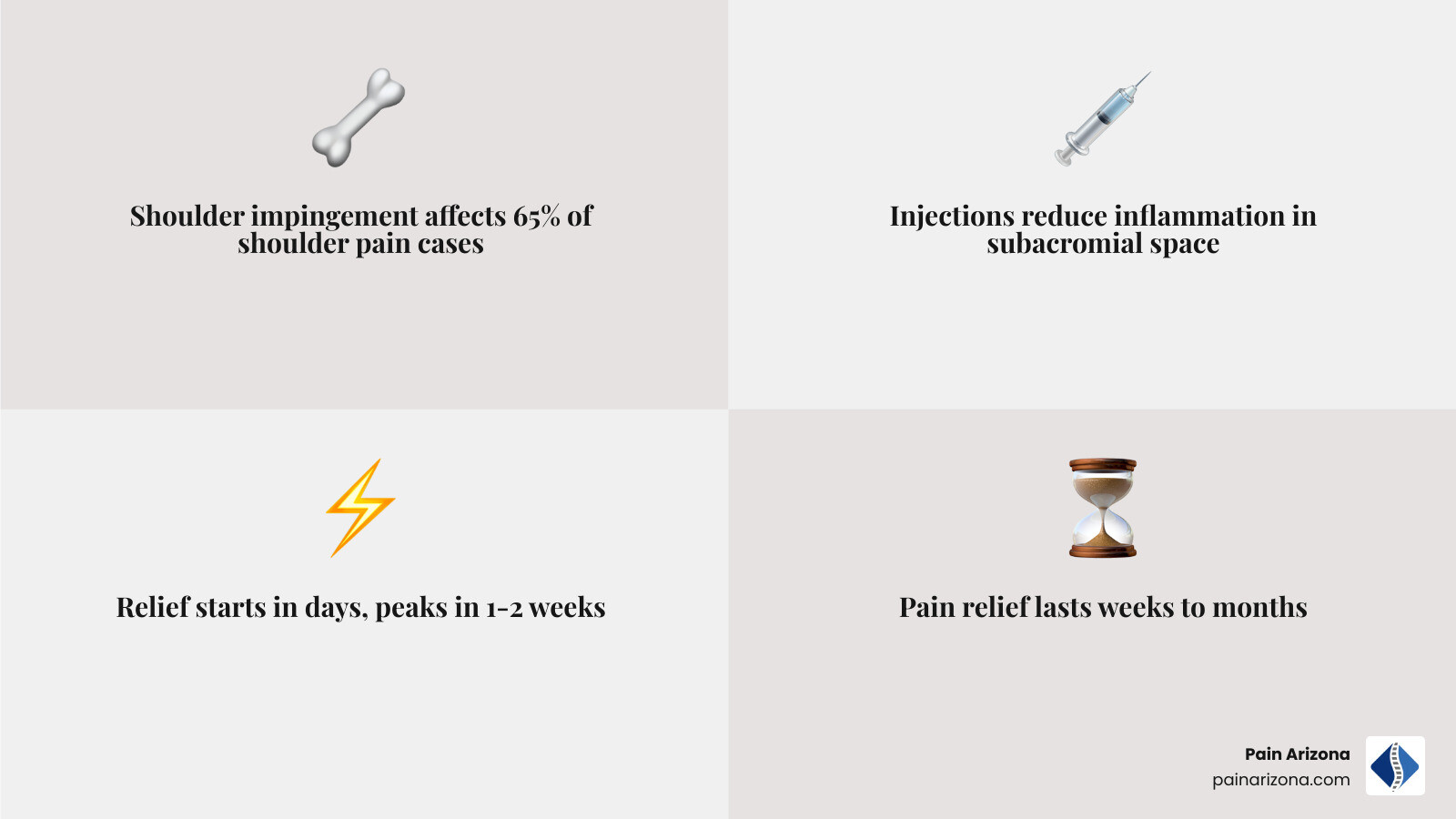
Shoulder impingement is the most common cause of shoulder pain, affecting over 65% of people who seek care for it. And research shows that one in three people will deal with significant shoulder pain at some point in their life. If you’ve been struggling with that sharp ache when you lift your arm — or the dull throb that keeps you up at night — you’re far from alone.
This guide walks you through everything: what’s actually happening in your shoulder, how injections work, what the procedure looks like, and whether it’s the right step for you.
I’m Dr. Nasser, a double board-certified physical medicine and pain medicine physician with extensive experience performing ultrasound- and fluoroscopy-guided shoulder impingement injections for patients across the Greater Phoenix area. Over the course of my career, I’ve helped thousands of patients move past the frustration of chronic shoulder pain using evidence-based, minimally invasive approaches tailored to each individual.
Easy Shoulder impingement injection glossary:
Understanding Shoulder Impingement Syndrome
Shoulder impingement syndrome happens when the rotator cuff tendons and the subacromial bursa get pinched or irritated in the narrow space under the acromion, the bony roof of the shoulder. You may also hear it called rotator cuff tendonitis, subacromial impingement, swimmer’s shoulder, or thrower’s shoulder.
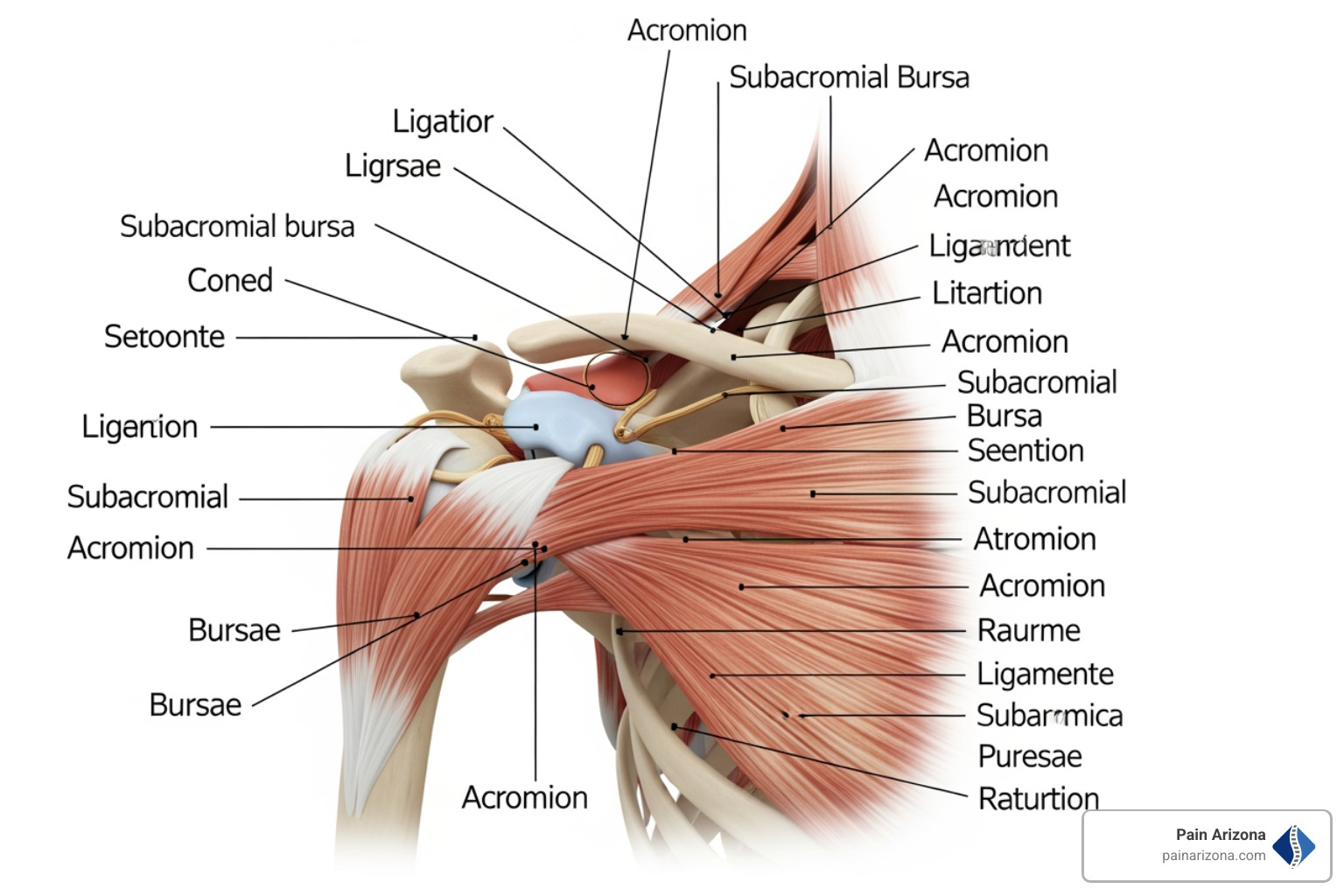
In simple terms: when you lift your arm, those tissues need room to glide. If that space becomes crowded or inflamed, each overhead movement can feel like your shoulder is filing a complaint.
Common causes include:
- Repetitive overhead activity, such as swimming, tennis, baseball, painting, or lifting
- Inflamed bursa or irritated rotator cuff tendons
- Bone spurs or acromion shape that narrows the space
- Muscle imbalance or poor shoulder blade mechanics
- Rotator cuff weakness
- Age-related wear and tear
- Less commonly, instability or other shoulder problems that mimic impingement
Common symptoms include:
- Pain when reaching overhead or out to the side
- Pain putting on clothes or reaching into a cabinet
- Night pain, especially when lying on that shoulder
- Weakness or pain-related loss of strength
- Painful arc of motion
- Reduced range of motion
Research has found measurable movement loss with shoulder impingement, including average deficits around 33% in external rotation and 29% in abduction. That helps explain why even simple things like shampooing your hair can suddenly feel like an Olympic event.
Diagnosis starts with a history and physical exam. We look at when the pain started, what movements trigger it, and whether weakness suggests a rotator cuff tear rather than pain-limited motion. Provocative tests such as Hawkins and Neer can help reproduce impingement pain.
Imaging may also help:
- X-rays can show bone spurs, arthritis, or acromial shape
- Ultrasound can evaluate bursitis, rotator cuff tendons, and biceps tendon problems
- MRI may be ordered if we suspect a significant tear, labral injury, or another structural problem
A useful point for patients: diagnostic musculoskeletal ultrasound can be highly accurate for rotator cuff problems, bursitis, and biceps tendon pathology, with reported accuracy up to 100% in some settings. In many cases, it gives us the answers we need without immediately jumping to MRI.
For more background, see our guides on Identifying Key Causes of Shoulder Pain and Signs and Risks of Rotator Cuff Tears.
The Role of the Shoulder Impingement Injection in Treatment
A shoulder impingement injection is usually considered when first-line treatment has not done enough. That typically means the shoulder still hurts despite some combination of:
- Activity modification
- Ice
- Oral anti-inflammatory medication
- Home exercises or physical therapy
The most common injectate is a corticosteroid, often paired with a local anesthetic. Corticosteroids are not the same as muscle-building anabolic steroids. They are anti-inflammatory medications designed to calm irritated tissue.
For shoulder impingement, the target is usually the subacromial space. The goal is to reduce inflammation in the bursa and around the rotator cuff so you can move with less pain and actually participate in rehabilitation.
Benefits may include:
- Reduced pain
- Improved range of motion
- Better sleep
- Easier participation in physical therapy
- Faster return to work, exercise, or daily tasks
The best way to think about injection therapy is as a bridge, not a magic eraser. It can lower pain enough for the real recovery work to happen. We cover the broader role of these procedures in our Comprehensive Guide to Shoulder Injections and Everything You Need To Know About Joint Injections. For a technical review of the evidence, see Efficacy of corticosteroid injection for subacromial impingement syndrome.
Diagnostic Utility of a Shoulder Impingement Injection
A shoulder impingement injection can also help diagnose the source of pain.
Here is how that works: if we place numbing medicine such as lidocaine into the subacromial space and your pain temporarily improves, that supports the diagnosis of subacromial impingement or bursitis. If strength returns once the pain is numbed, the weakness may have been pain-related rather than caused by a full-thickness rotator cuff tear.
That diagnostic role matters because shoulder pain can come from several places:
- Rotator cuff tendinopathy
- Rotator cuff tear
- Bursitis
- AC joint pain
- Glenohumeral arthritis
- Frozen shoulder
- Neck-related referred pain
A carefully placed injection can help separate these possibilities. This dual diagnostic and therapeutic use is described well in Diagnostic and Therapeutic Injection of the Shoulder Region | AAFP.
Comparing Injections to Physical Therapy
Patients often ask, “Should I get the shot or just do therapy?”
The honest answer is that both can help, and often the best results come from using them thoughtfully together.
A well-known randomized trial summarized by the AAFP found that corticosteroid injections and manual physical therapy both improved shoulder pain and disability by about 50% within one month. Those gains were largely maintained over a year, but many patients still had some lingering symptoms no matter which treatment they started with.
| Treatment | What it does best | Limitations |
|---|---|---|
| Cortisone injection | Faster pain relief, reduced inflammation, helps patients tolerate rehab | Relief may wear off, does not fix mechanics by itself |
| Manual physical therapy | Improves strength, mobility, and shoulder mechanics | Usually takes more time and active participation |
| Best combined approach | Uses pain relief to unlock effective rehab | Requires follow-through |
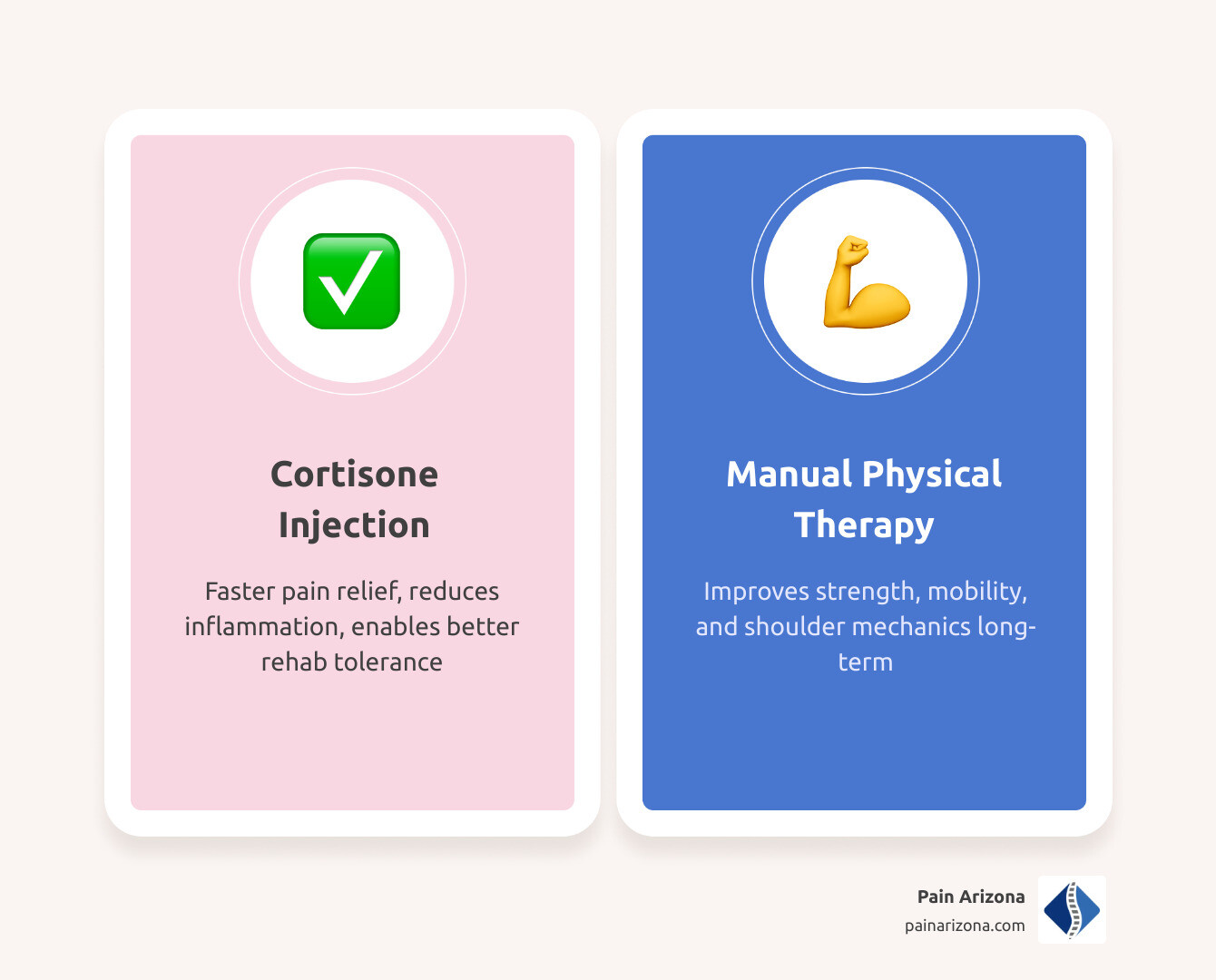
The takeaway: injections are not necessarily “better” than therapy, but they may help you do therapy better. See Injection Equals Physical Therapy for Shoulder Impingement | AAFP.
Types of Injections and Their Benefits
Not every shoulder injection is the same. Depending on your diagnosis, symptoms, and medical history, we may discuss different options.
Corticosteroid injections
These are the most common injections for shoulder impingement. Examples include:
- Methylprednisolone
- Triamcinolone
- Betamethasone
Benefits:
- Strong anti-inflammatory effect
- Often effective for bursitis and impingement-related pain
- Can improve sleep and range of motion
- Can serve a diagnostic purpose when combined with anesthetic
NSAID injections
In some cases, non-steroidal anti-inflammatory drug injections such as ketorolac may be considered. Research on NSAID injections in shoulder conditions suggests they can be a reasonable alternative for selected patients, especially when we want to avoid steroid exposure.
Potential advantages:
- Anti-inflammatory effect without corticosteroid-specific risks
- May be useful in patients where steroid side effects are a concern
Potential limitations:
- Not appropriate for everyone, especially patients with certain kidney, stomach, or bleeding risks
- The evidence base is smaller than for steroid injections in impingement
PRP and other non-steroid options
Platelet-Rich Plasma, or PRP, is sometimes discussed for shoulder tendon problems. It is not the standard first injection for classic shoulder impingement, but it may come up in conversations about tendinopathy or partial tears. Some studies suggest PRP may have better early results than steroids in partial rotator cuff tears, though results vary and it is not the right fit for every patient.
No matter the injectate, the key is matching the treatment to the actual pain generator. You can learn more in our pages on Fast Relief with Cortisone Shots and Intra-Articular Joint Injection Overview.
Procedure and Safety: What to Expect
Most shoulder impingement injections are done in the office and take only a few minutes.

A typical visit includes:
- Review of symptoms, exam findings, and imaging if needed
- Discussion of risks, benefits, and alternatives
- Skin cleaning with sterile technique
- Needle placement into the subacromial space
- Injection of anesthetic and anti-inflammatory medication
- Brief observation afterward
Ultrasound-guided vs landmark approach
There are two main ways to perform a shoulder injection:
- Landmark-guided: uses surface anatomy and palpation
- Ultrasound-guided: uses live imaging to see the needle and target tissue
Ultrasound guidance generally improves accuracy, especially in complex anatomy or when precision matters. Some research in musculoskeletal imaging shows ultrasound can be extremely accurate for diagnosing rotator cuff and bursal problems, and guidance can help us visualize the subacromial bursa directly.
Why this matters:
- More confidence that medication reaches the intended target
- Better ability to avoid nearby structures
- Helpful in patients with prior surgery, larger body habitus, or unclear anatomy
That said, outcomes do not always differ dramatically in every study just because the placement is more accurate. Good patient selection and follow-up rehab still matter a great deal.
For procedural background, see Shoulder Subacromial Injection Procedure.
Risks and Side Effects to Consider
Shoulder injections are generally safe when done properly, but they are still medical procedures, not spa treatments with extra paperwork.
Possible side effects and risks include:
- Temporary soreness at the injection site
- Steroid flare, or a short-term increase in pain after the injection
- Facial flushing
- Blood sugar elevation in people with diabetes
- Skin thinning or pigment change
- Bleeding or bruising
- Infection
- Rare allergic reaction
Reported statistics from the research are reassuring but important:
- Steroid flare occurs in about 1 in 20 patients
- Infection risk is less than 1 in 20,000
- Skin atrophy or pigment change occurs in less than 1 in 100
There are also longer-term concerns with repeated steroid exposure:
- Tissue weakening
- Tendon injury
- Cartilage damage with too-frequent injections
We are especially careful in people with:
- Uncontrolled diabetes
- Active infection
- Overlying cellulitis
- Bacteremia
- Significant bleeding risk
- Use of blood thinners
- Glaucoma
- Uncontrolled high blood pressure
- Allergy to injection components
For patients with diabetes, blood sugar can rise after a cortisone shot. That does not automatically rule out treatment, but it does mean we plan carefully and ask for closer glucose monitoring afterward. For more on safety, visit Joint Steroid Injection Safety.
Recovery and Rehabilitation After a Shoulder Impingement Injection
Recovery is usually straightforward, but what you do after the injection matters.
Typical post-injection guidance includes:
- Rest the shoulder from strenuous activity for about 48 hours
- Use ice if the area feels sore
- Expect possible numbness or immediate temporary relief from the anesthetic
- Understand that the steroid may take a few days to up to two weeks for full effect
- Resume guided rehabilitation once soreness settles
Rehab is the part many people want to skip. We get it. Exercises are less exciting than quick relief. But rehabilitation is what helps keep the pain from boomeranging back.
After pain calms down, therapy usually focuses on:
- Restoring range of motion
- Strengthening the rotator cuff
- Improving shoulder blade mechanics
- Correcting posture and movement patterns
- Gradually returning to overhead activity
In other words, the injection opens the door, and rehab walks you through it. Learn more about non-surgical options on our Shoulder Pain Treatment Options.
Frequently Asked Questions about Shoulder Injections
How long does a shoulder impingement injection last?
Most patients get relief for several weeks to a few months. Some improve for a shorter period, while others get longer benefit. It depends on:
- How inflamed the tissue is
- Whether there is also a tendon tear or arthritis
- Activity demands
- How well rehab is followed afterward
Also important: the numbing medicine may help right away, but the steroid itself often takes a few days to two weeks to reach full effect. For procedure details and broader shoulder injection context, see Shoulder Joint Injection Details | NCBI.
How many cortisone shots can I have in my shoulder?
A common practical limit is no more than 4 corticosteroid injections per year in the same region, and often fewer are preferred. In some studies of subacromial impingement, patients received up to three injections over a year.
Why limit them?
- Repeated steroid exposure can weaken soft tissue
- Too-frequent injections may increase tendon rupture risk
- They can mask pain without correcting the underlying problem
If you need repeated injections, we usually step back and ask why. Is the diagnosis incomplete? Is the rehab plan missing something? Is there a tear, bone spur, frozen shoulder, or arthritis driving the pain?
Who is not a candidate for these injections?
A shoulder impingement injection may not be a good choice, or may require special precautions, in people with:
- Uncontrolled diabetes
- Active infection anywhere significant in the body
- Skin infection over the injection site
- Bacteremia
- Certain bleeding disorders
- Current blood thinner use, depending on the medication and risk
- Allergy to the steroid, anesthetic, or prep solution
- Some cases of glaucoma or uncontrolled hypertension
Pregnancy, immune suppression, and recent surgery may also affect timing and decision-making. This is why an individualized medical review matters. Our Shoulder Pain Conditions page covers common shoulder pain sources in more detail.
When should surgery be considered if injections fail?
Most cases improve with non-surgical care, but surgery may be discussed when:
- Pain continues despite medication, therapy, and injections
- There is a significant rotator cuff tear
- Bone spurs or structural narrowing are a major factor
- Weakness and function keep getting worse
- Symptoms are limiting work, sports, or sleep for the long term
When surgery is needed, one common option is subacromial decompression, sometimes combined with rotator cuff treatment depending on the findings. Reported outcomes are generally favorable, with about 85% of patients returning to their previous level of shoulder function after surgical intervention. Still, surgery is usually not the first step.
Conclusion
A shoulder impingement injection can be an excellent option when shoulder pain is keeping you from sleeping, working, exercising, or simply lifting your arm without wincing. It can reduce inflammation, improve motion, and make physical therapy more productive. But the best results happen when the injection is part of a full plan, not the whole plan.
At Pain Arizona, we provide evidence-based, minimally invasive care for patients throughout the Greater Phoenix Area, including Mesa, Gilbert, Scottsdale, Glendale, and Phoenix. Our double board-certified physicians focus on finding the root cause of pain and building a treatment plan that fits your goals, health history, and lifestyle.
We accept most insurance plans. Check with our office manager to see if your plan is accepted.
If you’d like to find out whether an injection is the right next step for your shoulder, Schedule a Consultation for Joint Injections.