
Everything You Need to Know About Trigger Point Injections
When Muscle Knots Won’t Let Go: What You Need to Know About Trigger Point Injections
Trigger point injections are a minimally invasive procedure that deliver fast, targeted relief to painful muscle knots — and if you’re dealing with chronic muscle pain that hasn’t responded to stretching, massage, or medication, here’s what you need to know right away:
Quick Answer: What Are Trigger Point Injections?
| Question | Answer |
|---|---|
| What are they? | A small needle delivers anesthetic, saline, or corticosteroid directly into a tight muscle knot |
| Who are they for? | People with myofascial pain, tension headaches, fibromyalgia, or piriformis syndrome |
| How fast do they work? | Most people feel relief within 24–72 hours |
| How long does relief last? | Typically around one month, sometimes 2–4 months |
| Are they safe? | Yes — they are a common, generally well-tolerated outpatient procedure |
Muscle knots — technically called trigger points — affect roughly 85% of people at some point in their lives. They form when muscle fibers get stuck in a contracted state and simply won’t release. The result can be deep, aching pain that radiates far from where the knot actually lives.
For many people in the Greater Phoenix Area, that pain becomes a daily reality. Conventional treatments like rest, heat, and over-the-counter medications often fall short. That’s where trigger point injections become an important option.
I’m Dr. Nasser — a double board-certified PM&R and pain medicine physician with extensive experience performing ultrasound- and fluoroscopy-guided injections, including trigger point injections, for patients with complex and chronic pain conditions. In the sections below, I’ll walk you through everything you need to know — from how trigger points form to exactly what happens during and after the procedure.
Understanding Myofascial Pain and Muscle Knots
To understand how trigger point injections work, we first have to understand what myofascial pain actually is. The word “myofascial” combines myo (muscle) and fascia (the thin, spiderweb-like connective tissue sheet that wraps around every muscle, nerve, and organ in your body).
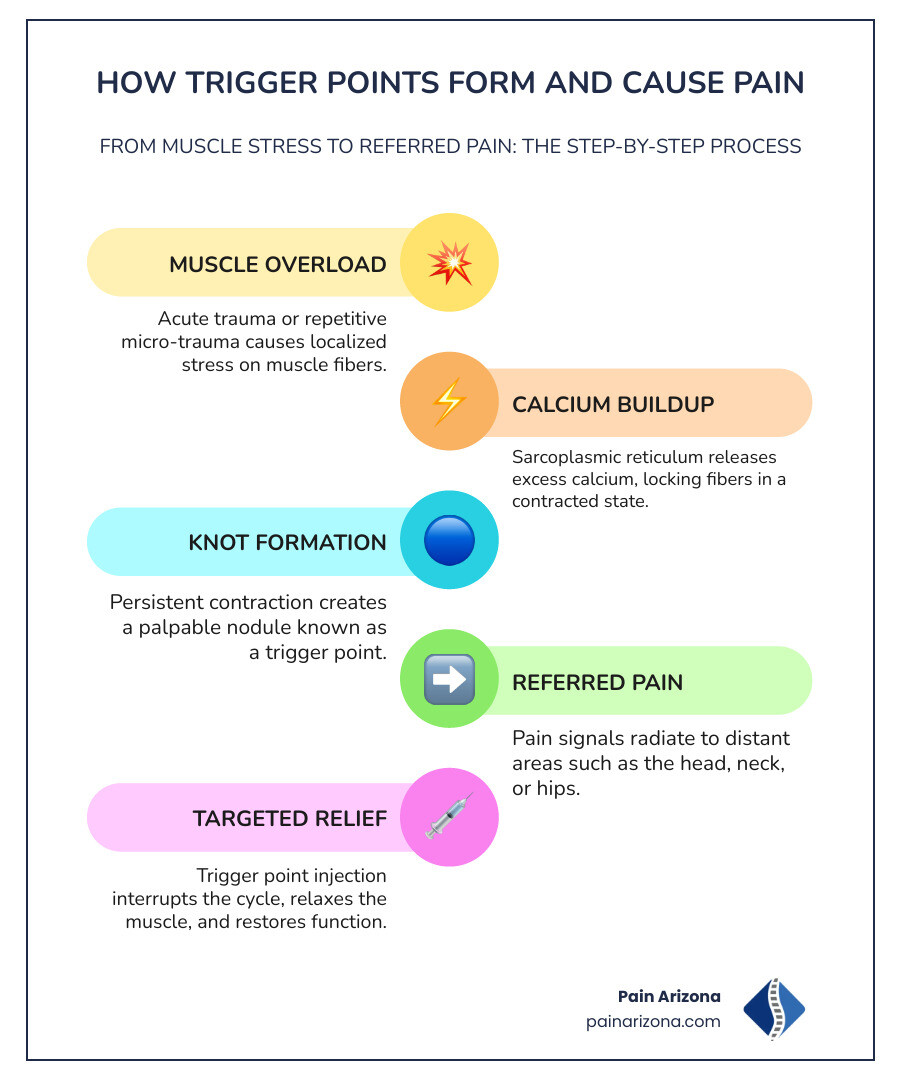
When your muscles are healthy, they contract and relax smoothly. However, when a muscle experiences stress, injury, or repetitive strain, specific fibers can lock up, forming a hard, palpable nodule. This is what we call a trigger point, or more informally, a “muscle knot.”
These knots were first comprehensively mapped and described in 1942 by Dr. Janet Travell, a pioneering physician who eventually became the personal doctor to President John F. Kennedy (whom she treated for severe back pain using these very techniques). Dr. Travell discovered that these points have a unique physiological signature.
At a microscopic level, a trigger point is an area of intense muscle hyper-contracture. Within the muscle cell, a structure called the sarcoplasmic reticulum becomes damaged or overstimulated. This causes a continuous, uncontrolled calcium release, which forces the surrounding muscle fibers to stay locked in a tight grip.
Because the muscle cannot relax, it consumes a massive amount of cellular energy (ATP) while simultaneously compressing local blood vessels. This restricted blood flow (ischemia) starves the tissue of oxygen and nutrients, leading to a buildup of acidic metabolic waste products. This toxic microenvironment sensitizes nearby nerve endings, sending persistent pain signals to your brain.
One of the most frustrating aspects of these knots is referred pain. This means that pressing on a trigger point in your shoulder might send a sharp or dull ache up into your neck, down your arm, or behind your eyes, mimicking other conditions.
What Are Trigger Points and How Do They Form?
Trigger points do not simply appear out of thin air. They typically develop due to a few common triggers:
- Acute Trauma: A sudden injury, such as a car accident, a slip-and-fall, or a sports injury, can tear or strain muscle fibers, causing them to spasm and lock.
- Repetitive Micro-Trauma: Chronic overuse is a massive culprit. Sitting at a desk with poor posture for years, repetitive lifting at work, or even carrying a heavy bag on one shoulder can cause constant micro-damage to your muscle fibers.
- Postural Stress: Slouching, forward head posture, and uneven weight distribution force certain muscle groups to remain constantly active to keep you upright, leading to exhaustion and knot formation.
When muscle fibers remain in this contracted state, they become highly sensitive to touch. If you are struggling with these stubborn, painful areas, exploring Phoenix trigger point therapy can help you understand the localized treatment options available to break this painful cycle.
Common Conditions Treated with Trigger Point Injections
While many people seek out these injections for general back and neck tension, they are highly effective for several specific, clinically diagnosed pain syndromes:
- Myofascial Pain Syndrome (MPS): This is a chronic pain disorder where pressure on sensitive points in your muscles causes pain in seemingly unrelated parts of your body.
- Fibromyalgia: Historically, fibromyalgia was diagnosed based on pain in 18 specific tender points. While the diagnostic criteria have evolved to focus on widespread pain, many fibromyalgia patients still experience highly active trigger points that respond well to targeted injections.
- Tension Headaches and Chronic Migraine: Muscle tightness in the trapezius, levator scapulae, and neck muscles can refer pain directly into the skull, triggering or worsening severe headaches.
- Piriformis Syndrome: When the piriformis muscle in the buttock becomes tight and develops trigger points, it can compress the nearby sciatic nerve, causing radiating leg pain that mimics a herniated disc.
If you are wondering whether your chronic muscle pain fits into these categories, reading through this comprehensive Cleveland Clinic guide on myofascial pain can help clarify how doctors identify and categorize these conditions.
What Are Trigger Point Injections and How Do They Work?
A trigger point injection is a straightforward, in-office procedure designed to physically disrupt the locked muscle fibers and soothe the irritated nerve endings.
We perform this by inserting a very fine needle directly into the center of the muscle knot. The physical action of the needle entering the knot helps to mechanically break up the taut band of muscle fibers.
To make the process more comfortable and to provide lasting relief, we typically inject a small amount of medication. The most common substances used include:
- Local Anesthetics: Medications like lidocaine or bupivacaine are the gold standard. They temporarily block the pain signals from the local nerves, allowing the muscle to relax.
- Corticosteroids: In some cases, a small dose of anti-inflammatory steroid is added to reduce local tissue inflammation and prolong the pain-relieving effects.
- Saline Injections: Studies have shown that even injecting a simple sterile saline solution can be highly effective, as the mechanical disruption of the needle is a major component of the healing process.
- Dry Needling: In some instances, no substance is injected at all. The mechanical stimulation of the needle alone is used to deactivate the point, though this can sometimes cause slightly more post-procedure soreness than an anesthetic injection.
The Science Behind Trigger Point Injections

The physiological magic of a trigger point injection lies in its ability to reset the muscle’s electrical and chemical state.
When the needle penetrates the hyper-contracted muscle fibers, it triggers a “local twitch response” — a brief, involuntary contraction of the muscle. This twitch is highly therapeutic; it indicates that the needle has successfully targeted the active knot.
Following this twitch, the muscle fibers experience a sudden, profound relaxation. This relaxation immediately relieves the compression on local blood vessels, allowing fresh, oxygenated blood to rush back into the tissue. This process replenishes cellular ATP, flushes out accumulated acidic waste products, and breaks the self-sustaining cycle of pain and spasm.
For a deeper look into the clinical mechanisms and anatomical considerations of this procedure, you can consult this StatPearls clinical review of trigger point injections. At Pain Arizona, we pride ourselves on utilizing evidence-based pain management to ensure that every needle placement is backed by rigorous clinical data and tailored to your specific anatomy.
Indications and Contraindications for the Procedure
While trigger point injections are incredibly useful, they are not appropriate for every type of pain.
Indications (When to get them):
- The presence of clear, palpable nodules within a taut band of muscle.
- A reproducible referred pain pattern when pressure is applied to the knot.
- A positive local twitch response during examination.
- Muscle-related pain that has failed to improve with conservative measures like physical therapy, massage, or oral medications.
Contraindications (When to avoid them):
- Absolute Contraindications: Active localized skin infection at the injection site, systemic blood infections, or a history of severe allergic reactions to local anesthetics.
- Relative Contraindications: Bleeding disorders or the use of heavy blood thinners (which increases the risk of local bleeding and bruising), pregnancy, or an extremely high BMI that makes accurate manual palpation of the muscle layers difficult.
For a detailed medical breakdown of the safety protocols and diagnostic criteria used by clinicians, take a look at the FPNotebook trigger point injection guidelines.
Comparing Injections with Less Invasive Therapies
Before moving forward with an injection, we always consider less invasive, first-line therapies. These conservative treatments are highly valuable and often work hand-in-hand with injections:
- Physical Therapy: Focuses on strengthening weak supporting muscles and stretching tight structures to prevent knots from returning.
- Massage Therapy: Uses manual pressure to slowly release superficial tension and improve local circulation.
- Osteopathic Manual Medicine & Myofascial Release: Employs specialized manual techniques to restore balance to the musculoskeletal system.
- Spray and Stretch Technique: Involves spraying a temporary cooling agent (vapocoolant) onto the skin to numb the sensory nerves, followed immediately by passive stretching of the underlying muscle.
To help you visualize how these treatments compare, we have put together this comparison table:
| Treatment Modality | Invasiveness | Primary Mechanism | Best For | Typical Recovery |
|---|---|---|---|---|
| Trigger Point Injections | Minimally Invasive | Mechanical disruption + local anesthetic chemical block | Stubborn, deep, or chronic knots that fail conservative care | 1–3 days of mild soreness |
| Dry Needling | Minimally Invasive | Mechanical disruption via acupuncture-style needles | Active muscle knots (no medication allergies) | 2–4 days of moderate soreness |
| Physical Therapy | Non-Invasive | Strengthening, stretching, and movement retraining | Long-term posture correction and preventing recurrence | None (immediate active participation) |
For patients seeking a comprehensive overview of how these different strategies are integrated into a modern, multimodal pain treatment plan, you can read this detailed PMC article on myofascial pain syndrome treatments.
The Injection Procedure: What to Expect
If you and your doctor decide that trigger point injections are the right path forward, there is no need to be nervous. The procedure is quick, performed right in our comfortable clinic rooms, and typically takes less than 15 minutes.
Patient Preparation and Step-by-Step Technique
Here is exactly what you can expect during your appointment:
- Positioning: Depending on where your knots are located, you will either sit upright on an exam table or lie comfortably on your stomach.
- Identification: We will carefully palpate (feel) your muscles to locate the exact center of the trigger point, marking the skin gently once the most tender spot is found.
- Sterilization: The skin over the marked area is thoroughly cleansed with an antiseptic solution to prevent any risk of infection.
- The Injection: Using a very thin, fine needle, we gently penetrate the skin and advance into the muscle knot at a 30-degree angle.
- The Fanning Technique: Once inside, we may use a rhythmic, fanning technique — gently advancing and redirecting the needle in several directions within the knot. This mechanical “needling” is highly effective at physically releasing the tight bands.
- Aspiration and Delivery: We always aspirate (pull back slightly on the syringe plunger) to ensure the needle is not inside a blood vessel. Once safety is confirmed, we slowly inject a small volume (usually 0.2 to 1 mL) of the anesthetic solution.
- Ultrasound Guidance: While many superficial injections can be safely performed using manual palpation, we often utilize state-of-the-art ultrasound guidance. This allows us to visualize the muscle layers, blood vessels, and nerves in real-time, ensuring maximum precision and safety.
To explore how modern imaging and clinical advances have made these procedures safer and more effective than ever, see this PMC review on trigger point injection advances.
Recovery, Aftercare, and Potential Risks
Once the injection is complete, we apply direct pressure to the site for a minute or two to prevent bruising, followed by a small adhesive bandage.
What to do after your injection:
- Keep Moving: We will guide you through some gentle, active stretching exercises immediately after the procedure to help the newly relaxed muscle fibers maintain their length.
- Rest: Avoid heavy lifting, high-intensity workouts, or prolonged standing for the first 24 to 48 hours.
- Manage Soreness: It is normal to feel some mild post-injection soreness for 3 to 4 days as the mechanical disruption heals. Applying an ice pack for 10 minutes at a time can provide great relief.
While TPIs are exceptionally safe, all medical procedures carry some minor risks. These can include temporary localized numbness from the anesthetic, mild bleeding or bruising, and a very low risk of infection. In rare cases where injections are performed near the rib cage, there is a tiny risk of a punctured lung (pneumothorax), which is why we utilize specialized techniques (like a pincer grip or ultrasound visualization) to completely avoid this.
If you are experiencing wider nerve-related pain alongside your muscle knots, understanding the difference between muscle-focused therapies and nerve-focused therapies like nerve block injections can help you navigate your recovery options.
Frequently Asked Questions About Muscle Knot Relief
How long do the effects of a muscle knot injection last?
Most patients begin to feel the muscle relax and pain subside within 24 to 72 hours after the procedure. If a local anesthetic was used, you may feel some immediate, temporary relief that wears off after a few hours, followed by the true, long-term relief a couple of days later. On average, the pain relief from a single injection session lasts about one month, though many of our patients enjoy relief lasting between 2 to 4 months, especially when the injection is paired with active physical therapy.
Are these injections painful?
Most patients tolerate the procedure incredibly well. The needle used is extremely thin — similar to the needles used for routine vaccinations. You will feel a quick pinch as the needle enters the skin. If we hit the active trigger point, you may feel a brief, deep ache or a quick muscle twitch, which is actually a great sign that we are in the right spot! The local anesthetic in the syringe quickly goes to work, numbing the area within seconds.
How often can you safely receive treatment?
To protect the health of your muscle tissue and avoid any potential side effects from repeated medication use (especially if a small dose of steroid is included), we generally recommend limiting trigger point injections to once every two months. If you have multiple active knots, we can safely treat several different muscle groups during a single office visit.
Conclusion
Muscle knots do not have to dictate your daily life or keep you from doing the things you love. Whether you are dealing with a stubborn shoulder knot from desk work, severe tension headaches, or complex myofascial pain, trigger point injections offer a safe, fast-acting, and minimally invasive path to relief.
At Pain Arizona, we specialize in comprehensive, compassionate chronic pain management across the Greater Phoenix Area. Our double board-certified physicians are dedicated to finding and treating the root cause of your pain, utilizing advanced diagnostics and precise, minimally invasive techniques to get you back on your feet.
We accept most insurance plans to ensure our treatments remain accessible. Simply check with our office manager to see if your specific plan is accepted.
If you are ready to say goodbye to chronic muscle pain and explore our advanced Pain Arizona injection treatments, contact our offices in Phoenix, Mesa, Gilbert, Scottsdale, or Glendale today to schedule your personalized consultation.