
Don’t Be a Pain in the Sciatic: Understanding Nerve Blocks
The Pain That Stops You in Your Tracks
Sciatic nerve injection is a minimally invasive procedure where medication—typically a local anesthetic and corticosteroid—is injected near the sciatic nerve or into the epidural space surrounding spinal nerve roots to reduce inflammation and block pain signals. The goal is to provide temporary relief from sciatica symptoms, allowing patients to participate in physical therapy and address the underlying cause of their pain.
What you need to know about sciatic nerve injections:
- Purpose: Reduce inflammation, block pain signals, and diagnose the source of nerve pain
- Types: Sciatic nerve blocks (target the nerve directly) or epidural steroid injections (target nerve roots in the spine)
- Relief Duration: Typically 2 weeks to several months, varying by individual
- Success Rate: 50-90% of patients experience significant pain relief
- Procedure Time: Usually less than 15-30 minutes, performed as an outpatient procedure
- Common Uses: Herniated discs, spinal stenosis, degenerative disc disease, piriformis syndrome
Nearly 80% of adults will experience lower back pain at some point in their lives. For many, that pain doesn’t stay put—it radiates down the leg, creating burning, shooting, or tingling sensations that can make simple activities like sitting, standing, or walking feel impossible.
This is sciatica. And if you’re reading this, you probably know exactly what it feels like.
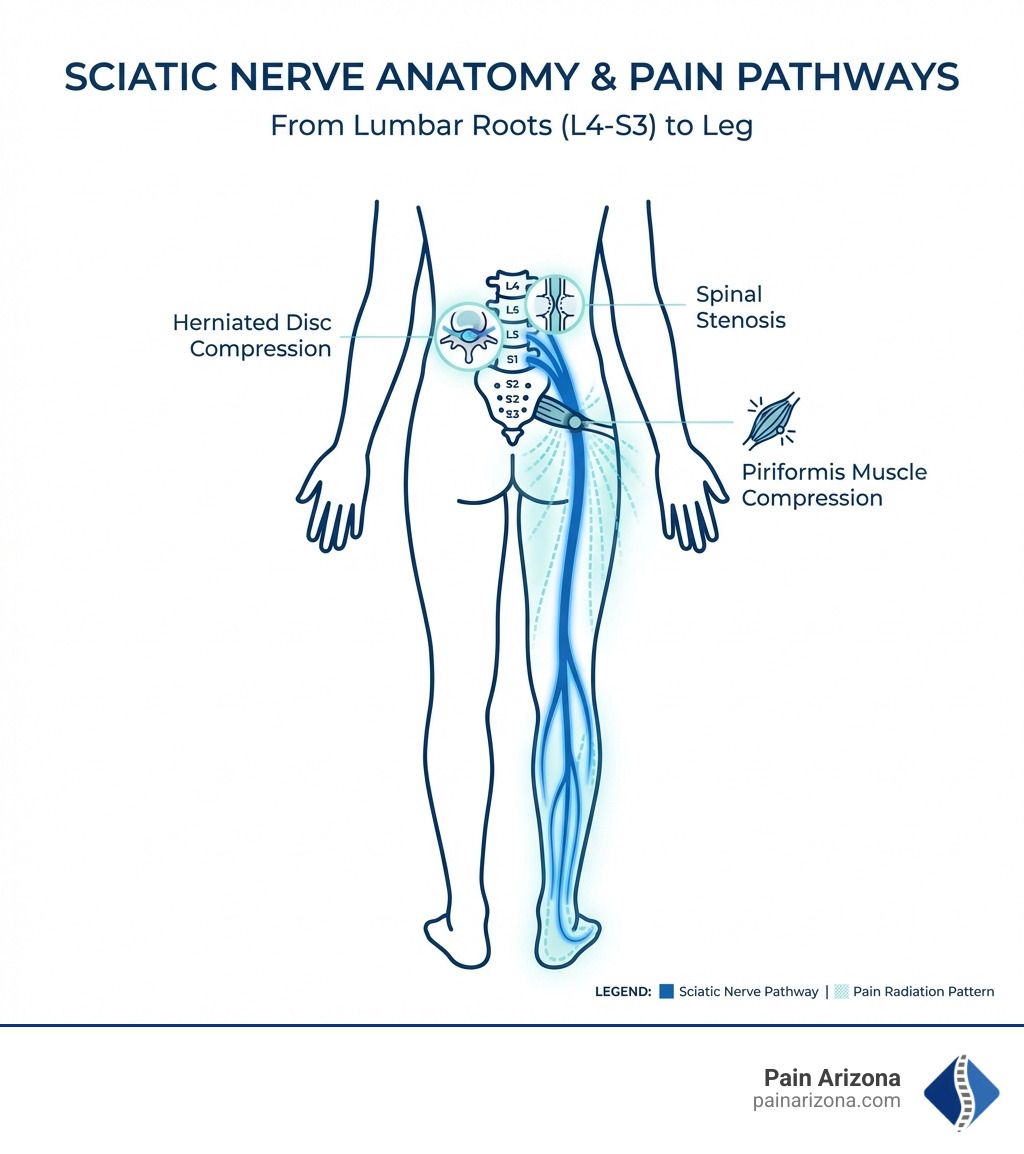
The sciatic nerve is the largest single nerve in your body, running from your lower spine through your hips and down each leg. When something compresses or irritates this nerve—a herniated disc, spinal stenosis, or bone spur—the result is often debilitating pain that can affect every aspect of your life. You might describe it as pins and needles, a sharp stabbing sensation, or a constant ache that won’t let up.
Traditional treatments like over-the-counter pain medications, rest, and physical therapy can help. But for many patients with persistent or severe symptoms, a sciatic nerve injection offers targeted relief that allows the body to heal and helps you regain function faster. These injections aren’t just about masking pain—they reduce inflammation at the source, interrupt pain signals, and can even help your doctor pinpoint exactly what’s causing your symptoms.
Understanding your options is the first step toward relief. If you’ve been suffering for more than four weeks, or if your pain is severe enough to interfere with daily activities, seeking early intervention can prevent the development of chronic pain syndrome. Learn more about Sciatica Demystified: Understanding Nerve Pain and Its Impact.
I’m Dr. Nasser, Chief Medical Officer at Pain Arizona, and I’ve performed tens of thousands of minimally invasive procedures, including sciatic nerve injections, to help patients across the Phoenix area find lasting relief. My approach combines advanced interventional techniques with a whole-person focus, ensuring we address not just your pain, but the root causes affecting your quality of life.
Find more about Sciatic nerve injection:
Understanding Sciatica: The Root of the Problem
Sciatica isn’t a condition itself; rather, it’s a symptom of an underlying problem affecting the sciatic nerve. This pain typically arises from nerve compression and inflammation in the lower back. Think of it like a garden hose: if something is pressing on it, the water flow is restricted. Similarly, when something presses on the sciatic nerve or its roots, it disrupts normal nerve function, leading to pain, numbness, tingling, or weakness that radiates along its path. This is often referred to as a Pinched Nerve.
In the United States, back pain is a pervasive issue, ranking as the fifth most common reason people seek medical care. Approximately 9% to 25% of individuals annually report experiencing low back pain that travels below the knee, a classic sign of radicular pain or sciatica.
The primary culprits behind sciatica, leading to the need for interventional pain management, include:
- Herniated Discs: This is one of the most common causes. When the soft, jelly-like center of a spinal disc pushes through its tougher exterior, it can press directly on a nearby sciatic nerve root. Herniated discs account for up to 10% of all lower back pain complaints.
- Spinal Stenosis: This condition involves the narrowing of the spinal canal, which can put pressure on the spinal cord and nerve roots. Degenerative lumbar spinal stenosis (DLSS), for instance, is the most common reason adults over 65 receive spinal surgery.
- Degenerative Disc Disease: As we age, our spinal discs naturally wear down, losing hydration and elasticity. This degeneration can lead to disc bulging, herniation, or bone spurs, all of which can irritate the sciatic nerve.
- Piriformis Syndrome: The piriformis muscle is a small muscle located deep in the buttock, near the hip joint. In some people, the sciatic nerve runs through or under this muscle. If the piriformis muscle becomes tight or inflamed, it can compress the sciatic nerve, causing sciatica-like symptoms.
- Spondylolisthesis: This occurs when one vertebra slips forward over another. This misalignment can pinch the nerve roots as they exit the spine.
Understanding these underlying causes is crucial, as it guides our approach to treatment. At Pain Arizona, our double board-certified physicians dig deep to diagnose the exact source of your pain, ensuring that any intervention, such as a sciatic nerve injection, is precisely targeted for maximum effectiveness.
Injection Therapies Explained: Sciatic Nerve Block vs. Epidural
When it comes to treating sciatica, we often turn to injection therapies for targeted relief. These procedures deliver medication directly to the source of the pain, offering a powerful alternative or complement to oral medications and physical therapy. While the term “nerve block” is often used broadly, it’s important to differentiate between a direct sciatic nerve block and a lumbar epidural steroid injection, as they target slightly different areas. Both aim to reduce inflammation and block pain signals, but their approach and specific indications can vary. Both can also serve as diagnostic tools, helping us pinpoint the exact nerve involved in your pain.
Learn more about the broader concept of Nerve Blocks: Immediate Relief from Severe Pain and specifically about Epidural Steroid Injections: Relief for Spinal Nerve Pain.
Sciatic Nerve Blocks
A sciatic nerve block involves injecting medication directly around the sciatic nerve itself, typically in the gluteal region or behind the knee, depending on the specific location of the pain. This approach directly bathes the nerve with medication, interrupting its ability to send pain signals to the brain.
The medication usually consists of a local anesthetic, like bupivacaine, to immediately numb the area and provide rapid, though temporary, pain relief. Often, a corticosteroid is also included to reduce inflammation around the nerve. This direct targeting is particularly useful for pain stemming from conditions like piriformis syndrome or when the pain is clearly localized to the sciatic nerve pathway outside the spinal canal. The procedure is performed outside the spine, making it distinct from epidural injections.
Lumbar Epidural Steroid Injections
A lumbar epidural steroid injection (lumbar ESI) targets the epidural space, a fatty area that surrounds the spinal cord and the spinal nerve roots as they exit the spine. Instead of blocking the sciatic nerve directly, this injection aims to reduce inflammation and irritation of the nerve roots that form the sciatic nerve. Lumbar ESIs are a common and invaluable nonsurgical treatment for low back pain radiating to the lower extremities (radicular pain), including sciatica.
The medication, a combination of a steroid (corticosteroid) and a local anesthetic, is injected into this space. The steroid reduces the swelling and inflammation around the irritated nerve roots, while the anesthetic provides immediate pain relief. This allows the nerve roots to heal and reduces the chemical irritation that often causes sciatic pain. This makes it an excellent option for conditions like herniated discs or spinal stenosis, where nerve roots are compressed or inflamed within the spinal canal. You can dig deeper into this treatment on our Lumbar Epidural Steroid Injection page.
Here’s a quick comparison:
| Feature | Sciatic Nerve Block | Lumbar Epidural Steroid Injection (ESI) |
|---|---|---|
| Target Area | Directly around the sciatic nerve (outside the spine) | Epidural space surrounding spinal nerve roots in the lower back |
| Purpose | Block pain signals, reduce inflammation of the sciatic nerve | Reduce inflammation of spinal nerve roots, alleviate radicular pain |
| Approach | Peripheral nerve block | Spinal injection (into the epidural space) |
Different Epidural Approaches
Lumbar epidural steroid injections can be administered via three primary routes, each offering distinct advantages depending on the patient’s specific condition and anatomy:
- Transforaminal Approach: This highly precise technique involves guiding the needle through the neural foramen (the opening where nerve roots exit the spine) to deliver medication directly to a specific nerve root. It’s considered superior for targeting a particular irritated nerve, often seen in cases of herniated discs causing unilateral sciatica. While effective, the transforaminal approach requires careful execution due to the proximity of blood vessels and nerves. Studies show good efficacy for lumbar disc herniations with this approach.
- Interlaminar Approach: In this method, the needle is inserted between the lamina (bony arches of the vertebrae) into the epidural space. The medication then spreads within the epidural space, affecting multiple nerve roots. This approach is less precise than transforaminal but can be useful for more diffuse pain or when multiple nerve roots are involved. It has shown similar efficacy to the transforaminal approach at 6 months, though transforaminal might offer earlier benefits.
- Caudal Approach: This is a more general approach where the needle is inserted through the sacral hiatus, a small opening at the very bottom of the spine (near the tailbone), into the caudal epidural space. The medication then flows upwards, affecting the lower lumbar nerve roots. It’s often simpler to perform and may be considered safer for some patients, particularly for widespread pain in the lower back and legs. A study in 2017 found caudal epidural steroid injection to be very successful in the short-term management of lower back pain, and a small-scale study in 2018 confirmed its consistent effectiveness for chronic, intractable lower back pain.
The choice of approach significantly influences both effectiveness and risk. For instance, the transforaminal route is theoretically superior for delivering medication near the exiting spinal nerve and dorsal root ganglion, but it carries a slightly higher risk of vascular complications if not performed carefully. Conversely, the caudal approach might be less precise but potentially safer in some contexts. We use fluoroscopic guidance with all approaches to ensure accurate needle placement and minimize risks. You can read more about the Effectiveness of different epidural approaches.
Furthermore, the type of steroid used can also impact safety. While particulate steroids were once favored for their theorized “depot effect” (longer-lasting action), non-particulate steroids (like dexamethasone) are increasingly preferred for transforaminal injections due to safety concerns. Animal studies suggest that intravascular injection of particulate steroids can cause neurological injury, whereas non-particulate steroids do not. The theoretical analgesic advantage of particulate steroids has not been consistently established for pain reduction or functional outcomes, leading us to prioritize patient safety.
The Sciatic Nerve Injection Procedure: A Step-by-Step Guide
Undergoing a sciatic nerve injection can sound intimidating, but rest assured, it’s a minimally invasive procedure performed in an outpatient setting by our experienced pain management specialists. Our goal is to make you as comfortable as possible while precisely targeting the source of your pain. Many patients ask, “Is the injection painful?” Most patients feel only mild discomfort, often described as a quick pinch or pressure, as the local anesthetic is administered. The actual injection is usually well-tolerated.
Before the Injection
Preparation for your sciatic nerve injection begins with a thorough review of your medical history. We’ll discuss any medications you’re currently taking, especially blood thinners, which might need to be adjusted or temporarily stopped before the procedure to minimize the risk of bleeding. It’s crucial to inform us about any allergies, infections, or other medical conditions you have. For instance, injections are typically not given if you have an active infection, bleeding disorder, uncontrolled diabetes, or certain heart conditions.
If you opt for sedation, which many of our patients in Phoenix prefer for comfort, you’ll need to arrange for a responsible adult to drive you home afterward. In this case, we also typically advise fasting for about six hours prior to your appointment. On the day of the procedure, you’ll wear a gown, and we’ll ensure you’ve used the restroom before we begin.
During the Sciatic Nerve Injection
Once you’re comfortably positioned (this might be on your stomach, back, or side, depending on the specific injection site), the injection area will be carefully cleaned and numbed with a local anesthetic. This is where you might feel that “quick pinch.”
The most critical aspect of the procedure is precise needle placement, which we achieve using advanced imaging guidance.
- Fluoroscopy (Live X-ray): This is our go-to for spinal injections. Fluoroscopy provides real-time, moving X-ray images, allowing our physician to visualize the needle’s path as it approaches the target nerve or epidural space. This ensures extreme accuracy and minimizes the risk of complications. For example, during transforaminal injections, we look for anatomical landmarks like the “Scottie dog” appearance on an oblique fluoroscopic view.
- Ultrasound Guidance: For direct sciatic nerve blocks performed outside the spinal canal, ultrasound guidance is often employed. Ultrasound offers real-time visualization of soft tissues, nerves, and vessels, helping us precisely deliver the medication and avoid surrounding structures. This approach reduces the risk of complications and improves patient outcomes.
After the needle is positioned, a small amount of contrast dye is injected. This dye helps us confirm that the medication will flow to the correct area and that the needle is not inadvertently in a blood vessel. Once proper placement is verified, the therapeutic medication (local anesthetic and corticosteroid) is carefully injected. The entire injection process typically takes less than 15-30 minutes. You might feel a tingling or mild burning sensation, or simply a feeling of pressure, as the medication enters the area.
After the Injection
Following your sciatic nerve injection, you’ll be moved to a recovery area for a brief observation period, usually around 30 minutes. During this time, our medical team will monitor you for any immediate side effects and ensure you’re feeling well before discharge.
It’s common to experience temporary numbness or weakness in the affected leg for a few hours due to the local anesthetic. This is why, if you received a sciatic nerve block, you might need a walker and an accompanying driver as your limb will be temporarily “frozen.” You may also notice some soreness or mild discomfort at the injection site for a day or two. Applying an ice pack (15-20 minutes every few hours for the first 48 hours) can help reduce swelling and soothe any soreness.
We’ll provide specific post-procedure guidelines, which typically include limiting strenuous activities, heavy lifting, and prolonged sitting for a short period. Staying hydrated is also beneficial for recovery. Most patients can resume their normal activities the day after the injection. We always advise watching for any signs of infection (like redness, warmth, or fever) or unusual side effects and reporting them to our office immediately.
Outcomes: Efficacy, Risks, and Your Recovery Plan
The decision to pursue a sciatic nerve injection is often driven by the hope for significant pain reduction and improved mobility. While these injections can offer considerable relief, it’s important to understand that they are generally a temporary solution, part of a broader, comprehensive pain management strategy. The evidence supporting corticosteroid injections for sciatica, as reviewed by organizations like Cochrane, suggests they are probably slightly better than placebo in reducing leg pain and disability at short-term follow-up. However, the treatment effects were often small and may not always be considered clinically important by patients. Despite this, for many, even small improvements can make a world of difference in daily life. Learn more about the Evidence for corticosteroid injections.
Goals and Benefits of a Sciatic Nerve Injection
Our primary goals for a sciatic nerve injection are multifaceted:
- Pain Control: The most immediate and desired benefit is to significantly reduce or eliminate the radiating leg pain associated with sciatica.
- Reduced Inflammation: Corticosteroids are powerful anti-inflammatory agents. By delivering them directly to the irritated nerve, we aim to calm the inflammation that contributes to your pain.
- Diagnostic Information: Sometimes, the injection itself can help confirm the precise source of your pain. If the block provides significant relief, it helps us confirm that the targeted nerve or nerve root is indeed the culprit.
- Postponing or Avoiding Surgery: For many patients, these injections can provide enough relief to delay or even eliminate the need for more invasive surgical interventions.
- Facilitating Physical Therapy: When pain is severe, engaging in physical therapy can be challenging. An injection can provide a window of reduced pain, allowing you to participate more effectively in physical therapy, strengthen core muscles, and improve flexibility, which are crucial for long-term recovery.
Success Rates and Duration of Relief
The success rates for sciatic nerve injection procedures can vary. Available research indicates generally favorable results, with 70% to 90% of patients experiencing pain relief from these injections. However, individual experiences vary depending on the cause of sciatica and other health factors. For instance, sciatic nerve blocks can offer significant pain relief, ranging from 50-90%.
The duration of pain relief is also quite variable. While some individuals may experience relief for just a couple of weeks, for many, it lasts for several months. Lumbar epidural steroid injections most often lead to temporary pain relief that lasts for three months or more, but some people may experience less or no pain relief. Typically, if the initial injection is effective, up to 3 injections may be given in one year. The pain relief from a sciatic nerve block usually lasts between two weeks to a few months. These procedures provide temporary relief, and they are most effective when integrated into a comprehensive treatment plan.
Potential Risks of a Sciatic Nerve Injection
While sciatic nerve injections are generally safe, like any medical procedure, they carry potential risks and side effects. Our double board-certified physicians at Pain Arizona take every precaution to minimize these, using image guidance and sterile techniques.
Common, less severe side effects can include:
- Temporary soreness or bruising at the injection site.
- Temporary numbness or weakness in the leg, which resolves as the anesthetic wears off.
- Headache, which can occur after epidural injections, though it’s usually mild and temporary.
- Temporary increase in pain initially, before relief sets in.
- Facial flushing or feeling warm.
More serious complications are rare but can include:
- Infection: Although sterile techniques are used, there’s always a small risk of infection.
- Bleeding: Especially if you’re on blood-thinning medications.
- Nerve Damage: While rare, direct nerve injury or damage to the spinal cord is a serious concern, particularly with transforaminal approaches where the needle is close to the nerve roots and arteries.
- Allergic Reaction: To the medications or contrast dye used.
- Dural Puncture: A rare complication where the needle punctures the dura mater, potentially causing a spinal headache.
- Steroid Side Effects: These can include temporary elevation of blood sugar (especially for diabetics), fluid retention, mood swings, or adrenal suppression. For women, irregular periods have also been reported. Long-term use of steroids can lead to osteoporosis, which is why we limit the number of injections per year.
We will thoroughly discuss all potential risks and benefits with you, ensuring you are fully informed before proceeding.
The Role of Physical Therapy and What’s Next
A sciatic nerve injection is rarely a standalone cure. It’s most effective when it serves as a bridge to allow you to engage fully in a comprehensive recovery plan. This plan almost always includes physical therapy. By reducing your pain, the injection enables you to participate in targeted exercises, strengthening core muscles and improving flexibility without being hindered by severe discomfort. This is where the real, lasting changes happen. Our approach at Pain Arizona emphasizes this integration, guiding you towards Physical Therapy: A Hands-On Approach to Pain Relief and other rehabilitative strategies.
But what if the injection doesn’t work? If a block doesn’t provide relief, it might mean the pain source isn’t entirely sciatic nerve-related, or other factors like nerve damage severity or block duration are involved. It could also indicate that the pain is coming from a different structure than initially suspected. In such cases, we would explore alternative approaches. This could include other types of injections (such as facet joint injections if your pain is coming from the small joints in your spine), advanced interventional pain management techniques, or even Regenerative Medicine options like PRP or stem cell therapy, depending on your specific diagnosis. Our goal is always to find the most effective, least invasive path to your relief.
Conclusion: Taking the Next Step Towards Sciatica Relief
Living with sciatica can be incredibly frustrating, turning simple daily tasks into agonizing challenges. At Pain Arizona, we understand the profound impact this pain can have on your life. A sciatic nerve injection, whether a direct nerve block or a lumbar epidural steroid injection, offers a powerful tool in our arsenal against this debilitating condition.
These injections can provide significant, often rapid, pain relief by directly addressing inflammation and blocking nerve signals. This allows you to break free from the cycle of pain, regain mobility, and actively participate in physical therapy—a critical component for long-term recovery and preventing future episodes. While not a standalone cure, it serves as a vital part of a comprehensive, personalized treatment plan designed to get you back to living your life to the fullest.
Our double board-certified physicians at Pain Arizona are dedicated to providing compassionate, evidence-based, and minimally invasive treatments. We focus on finding the root cause of your pain and tailoring a plan that works for you. We accept most insurance plans, and our office manager can help you verify your coverage.
If you’re in the Phoenix, Mesa, Gilbert, Scottsdale, or Glendale area and struggling with sciatica, don’t let pain dictate your life. Take the next step towards relief and explore how our advanced treatments can help. Find lasting relief with advanced joint injections and other innovative solutions offered at Pain Arizona.